Xidi and Hongcun in one day: water spaces, village lanes and the Hu Wenguang archway
Choose a clear walk in each of Anhui’s two UNESCO villages: South Lake to Moon Pond in Hongcun, then the Hu Wenguang archway and an interpreted house in Xidi. This guide explains when to choose just one, how to arrange the middle transfer, and what to look for beyond their shared white walls and dark roofs.
Choose a village experience before choosing a transfer
Xidi (西递) and Hongcun (宏村) are two separate villages in Yi County, within Huangshan City in southern Anhui. Their UNESCO listing concerns the combination of settlement layout, houses, decoration and water systems, rather than a single spectacular building. The shared white walls and dark roofs can make a rushed photo stop feel repetitive. The rewarding comparison is different: Hongcun makes its water spaces immediately legible, while Xidi rewards attention to the transition from its monumental village entrance into enclosed lanes and house interiors.
If you have only one unhurried half-day, choose Hongcun for a water-led walk with two contrasting open spaces, or Xidi for the entrance archway and a concentrated look at domestic architecture. With a full day and confirmed transport, visit both but protect a proper pause between them. The two names are not alternate names for one attraction, and a booking for one does not establish admission to the other. Do not add a Huangshan mountain ascent simply because all three places appear in the same regional search result.
References: 1
Arrange the day around the actual village entrances
For a two-village day, ask your accommodation or transport provider to write the names, pickup points and return arrangement in Chinese. Confirm whether the quoted service connects the scenic-area visitor centres, particular parking areas or an accommodation outside a gate. Save both exact pins. A convenient-sounding ride to Hongcun may still leave you arranging a separate ride to Xidi, so settle the middle leg before the first walk. This guide does not invent a fixed transfer duration or current public-bus schedule.
Buy the current named admission product through the responsible service and check its validity, identity-document requirements and re-entry terms. This research verified the heritage places and their distinctive features, not a live operator price or opening calendar. If sleeping in a village, ask your host how luggage reaches the property, which entrance to use and whether arrival still requires an admission procedure. Keep the daylight walking plan independent of an unconfirmed promise that an inn booking includes everything.
Hongcun: begin with South Lake, then enter the lanes
Use South Lake, Nanhu (南湖), as the first broad orientation point on the current visitor map. Hongcun's southern water space and its central Moon Pond are distinct places. At the lake, look from an unobstructed public section toward the village edge before moving inward. Notice the long view of rooflines and hills, then how quickly that view narrows as you approach a lane. You will understand the later pond stop better if you first experience the difference between the outer village edge and the interior.
A sensible sequence is South Lake, the signed route toward Moon Pond, and one currently open interpreted building before returning to a clear exit. Nanhu Academy (南湖书院) is a useful named option to ask about at the start; confirm whether it is open and included rather than assuming every historic doorway is accessible. In the lanes, stay beside the visitor flow when pausing over a water channel. A channel can be part of the settlement's infrastructure without being a safe place to wash hands, dip a bottle or step across for a photograph.
Moon Pond: walk the edge instead of chasing a reflection
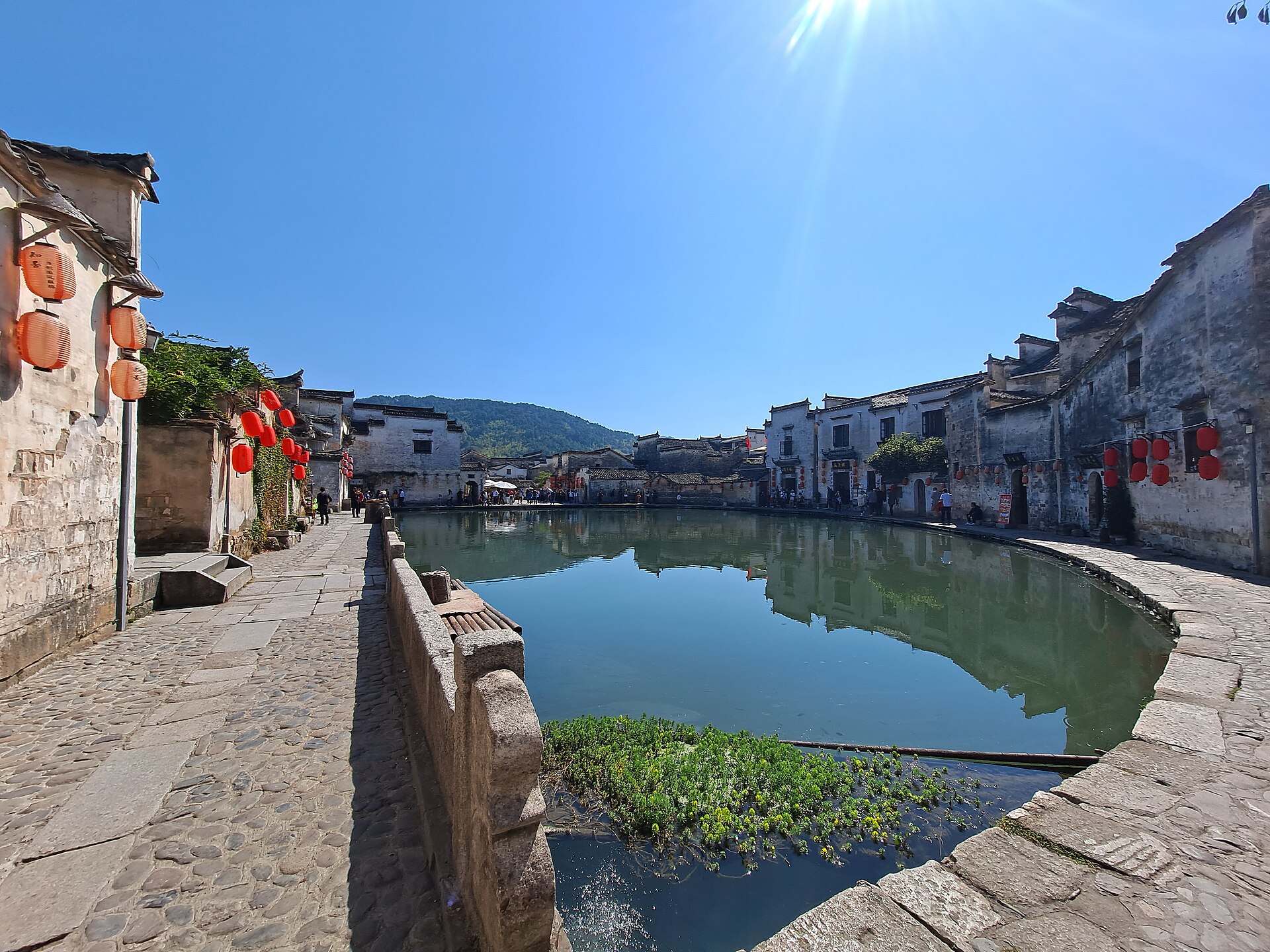
Moon Pond, Yuezhao (月沼), is the compact central water space shown in the lead photograph. The real 2022 image is useful for scale: the pond is bordered closely by houses and a narrow walking edge, not surrounded by an empty park. Walk part of its perimeter and let the view change. A broad first view shows the enclosure; a second position helps you see how entrances and paths meet the water. If a section is busy, continue to the next suitable stopping place instead of turning the edge into a queue for a single camera position.
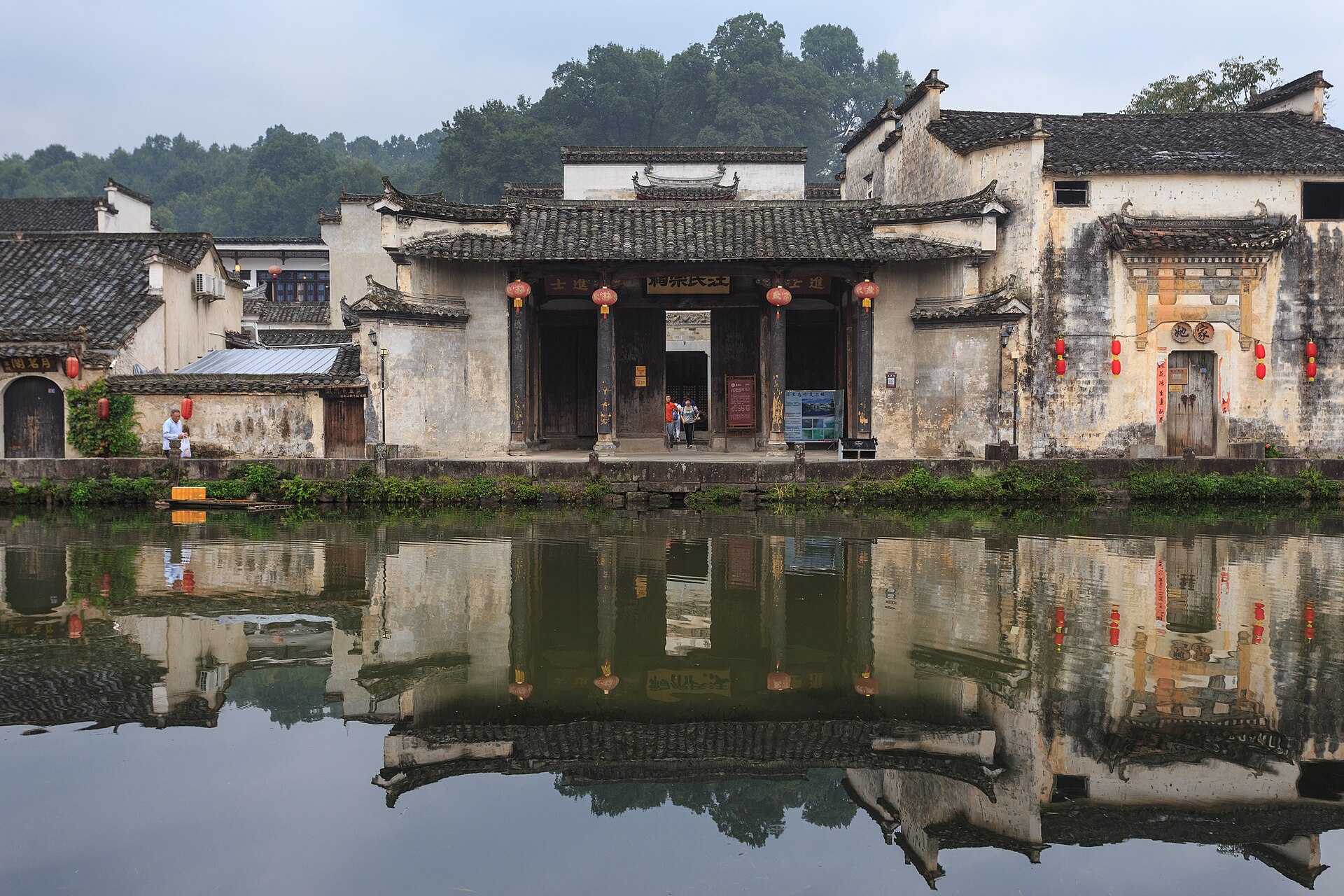
Lexu Hall, Lexutang (乐叙堂), is the named ancestral-hall stop associated with this area in the tourism observatory's original field report. The second Hongcun photograph shows its actual frontage across Moon Pond. Match that view to current signs and ask about permitted entry. If the hall is closed, the water-edge relationship is still readable from outside. Inside any building that is open, seek its identification and function before describing it as a merchant's private house; the village contains different kinds of social space.
Xidi: use the Hu Wenguang archway as a deliberate beginning
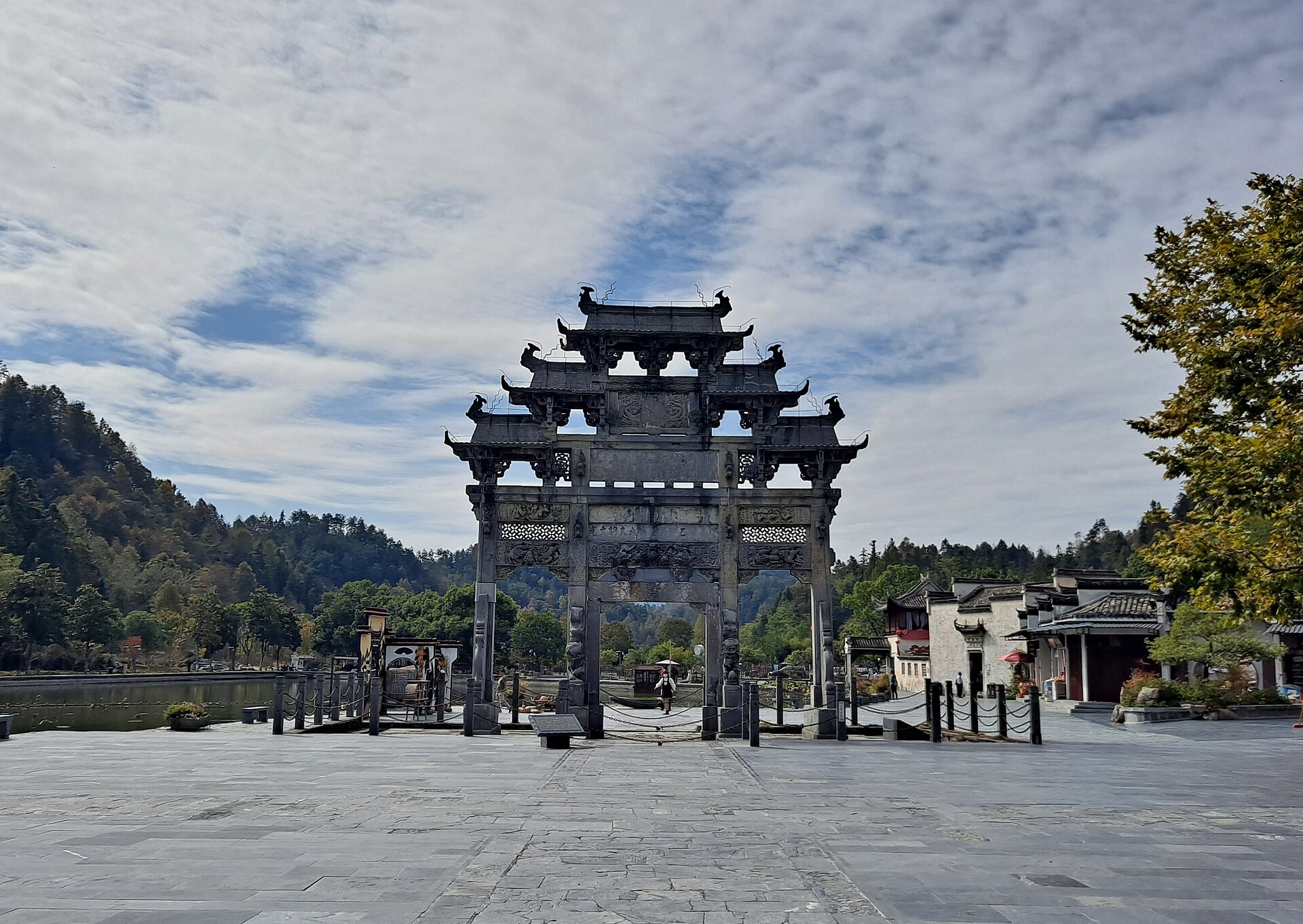
At Xidi, locate the Hu Wenguang memorial archway, Hu Wenguang cishi paifang (胡文光刺史牌坊), on the current map. Huangshan's municipal guide identifies the village-front monument with the local Ming official Hu Wenguang. The supplied 2022 photograph shows the archway itself, including the open setting around it and the village buildings beyond. Start with enough distance to see the whole form, then move only along the permitted route for a closer look at its worked stone.
Use the monument to establish the difference between an approach space and the lanes ahead. From the open area, follow a signed public route into the village and look back once you have reached a safe stopping place. The archway's breadth and the compressed view between white walls make a much stronger comparison than ten nearly identical photographs of roofs. Do not interpret an entrance arch as a fortification or assume that a ceremonial monument gives unrestricted access to every neighboring house.
Select one open interior and look at how the house admits light
Ask the village visitor service which historic house or hall is open for interpretation that day, and use its exact name on your map. Xidi's municipal introduction highlights wood and brick carving, but a satisfying visit is not a contest to find the largest amount of ornament. In a permitted interior, let your eyes adjust and look first at the connection between entrance, courtyard or light well, circulation and principal room. Then select one labelled carved detail to examine in context.
A useful comparison is the amount of sky visible from a lane and from the house's open-to-sky space. Consider what the openings allow you to see while leaving other rooms private. Ask a guide which parts are original, restored or subsequently adapted; appearance alone cannot date a timber member. Keep bags away from carved surfaces and avoid flash where prohibited. If the only available interior is crowded, a short attentive visit is better than obstructing a doorway while waiting for an empty-room photograph.
References: 6
Make the pairing enjoyable in rain, heat or crowds
Give each village one main purpose and leave room for ordinary needs. In Hongcun, retain South Lake and Moon Pond even if you drop an extra interior. In Xidi, retain the archway, a short public-lane sequence and one good interpreted building. Find a place to sit and eat between them rather than buying food only when the group is already late for the next pickup. If the first village takes longer than expected, shorten the second by choice instead of hurrying both.
Stone paving, thresholds, water edges and changing levels deserve attention, particularly after rain. Ask about the actual accessible route if anyone needs step-free access; a village-wide scenic-area label does not answer that question. Keep children close beside channels and ponds, and keep wheeled luggage out of the sightseeing plan. Heavy rain is a reason to choose a simpler route and usable shelter, not to follow an isolated lane in pursuit of a quieter image. Respect notices and any locally imposed closure.
Photograph named places and respect the inhabited village
Take one orienting view at each named stop, one architectural relationship and one permitted detail. Label files with Xidi or Hongcun immediately: the shared palette makes a later misidentification surprisingly easy. The photographs here are specifically Moon Pond in Hongcun, Lexu Hall beside Moon Pond and the Xidi archway. They are dated records, not promises about current water level, open doors, lanterns or visitor numbers. A good photograph should help the next traveller understand where they are.
Keep shop visits and residents' homes separate from interpreted attractions. Ask before photographing someone closely, avoid looking through private windows and leave a lane passable for deliveries. At the end, choose the place that best served your own interest rather than deciding that one village is the authentic version of the other. If you can describe how Hongcun's public water spaces and Xidi's entrance-to-house sequence shape the walk, the pairing has done more than supply matching white-wall pictures.
A realistic two-village shape
Allow an editorial planning block of roughly three hours for Hongcun and two to three for Xidi, with separate time for lunch and the confirmed transfer. These are flexible visit allowances, not measured walking or queue times. Reverse the order if accommodation and transport make that simpler. With only a short afternoon, remove one village entirely and enjoy a complete walk in the other.
Questions
Which village is the better single choice?
Choose Hongcun for a walk organized around the contrasting water spaces of South Lake and Moon Pond. Choose Xidi if the archway, lanes and a well-explained historic interior interest you more. Either can sustain a worthwhile half-day without the other.
Can the heritage listing serve as a combined ticket?
No. A shared UNESCO inscription describes heritage significance. Confirm each village’s current admission arrangements and any genuinely available combined product with its responsible visitor service before purchasing.
Sources and photography
- UNESCO: Ancient Villages in Southern Anhui – Xidi and Hongcun
- Huangshan municipal government: Hongcun Village
- UNWTO Sustainable Tourism Observatory of Xidi-Hongcun: original Hongcun field report, 2012/2013
- EditQ: Moon Pond, Hongcun
- Zhangzhugang: Hongcun Moon Pond and Lexu Hall
- Huangshan municipal government: Xidi and Nanping Village
- EditQ: Xidi Archway
Photographs are credited beside each image. Their recorded capture dates describe the images; check the current visitor or product information linked above when planning.