Kulangsu: build a small facade vocabulary on foot
An island with varied architecture is easier to remember through a few repeatable observations than a long sequence of mansion names. On Kulangsu, collect a small vocabulary of entrances, openings, balconies and rooflines from public routes. The goal is to notice combinations while leaving historical attribution to documented interpretation.
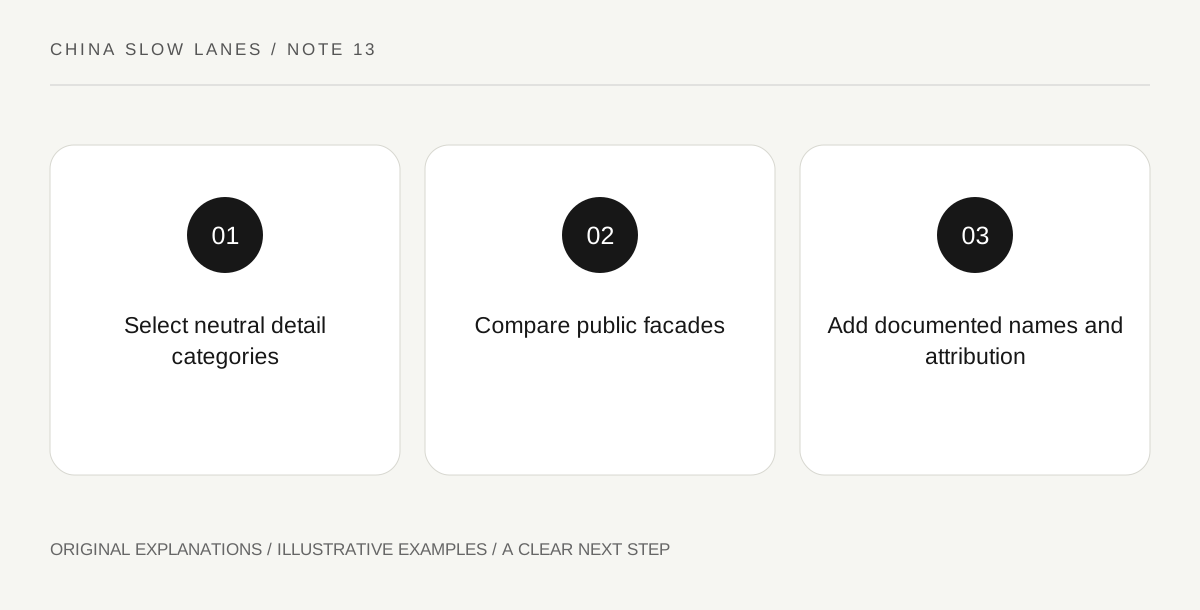
Original explanatory diagram. Read the full method and limitations below.
Choose four neutral words
UNESCO identifies Kulangsu as an international settlement with architecture shaped by cultural exchange. Before starting a walk, write four headings: entrance, opening, projecting element and roofline. These ordinary categories work even when you do not know formal style names. At each selected public stopping point, fill only the headings that are clearly visible. An incomplete card is better than a guessed detail. This approach shifts attention from whether you can identify a famous house to how individual buildings organize their visible surfaces.
Compare details at the same scale
Choose two buildings that can be viewed lawfully and comfortably from public space. Compare entrance with entrance or opening with opening, rather than comparing an entire facade with a cropped ornament. Describe proportion, repetition and position in plain language. If one building is screened by vegetation, record that limit and select another detail. The point is a fair visual comparison, not the removal of every obstruction for a photograph. Respect gates, occupied homes and signs governing photography, and keep narrow paths open for people who are simply going about their day.
Add style names after the observation
If a reliable panel identifies a style or architect, add that information in a separate line. Do not reverse the process by deciding that a familiar column proves a whole building’s origin. The heritage description emphasizes combinations, including Amoy Deco, rather than a tidy division into wholly Chinese and wholly foreign buildings. Your detail cards can show why such mixed histories are interesting. A repeated feature may appear in different combinations, and one facade may resist the first category that comes to mind.
Make the walk legible afterward
At the end, select four observations that can be explained without the photographs. Write a short glossary using your own descriptions and keep the actual building names or locations beside them. This makes the material useful when you later read more about the island. It also prevents an unlabeled camera roll from becoming the main record of the day. Plan island arrival and departure through current official arrangements separately; the facade exercise is a flexible activity within a lawful visit, not a promise of any particular ferry or access route.
Illustrative field exercise
Illustrative glossary: a visitor records a recessed entrance, a repeated row of openings, a projecting balcony and a stepped-looking roofline from four permitted viewpoints. A panel supplies a style name for only one building. The glossary preserves that distinction. Later, the visitor can compare the details with an architectural guide without pretending that all four were confidently classified during the walk.
Questions that come up
Is it useful to look without knowing architectural terminology?
Yes. Precise everyday descriptions create a foundation for learning the terminology later. A wrong technical label is less useful than a clear account of what you actually saw.
Does the article provide an island transport route?
No. Arrival arrangements and permitted routes need current official information. The observation exercise can be shortened or rearranged around the visit you are able to make.
References and scope
These sources support the factual background. Examples and exercises are original illustrative teaching material. References do not imply endorsement.
- UNESCO: Kulangsu, a Historic International Settlement — The island’s settlement history, varied architecture and cultural fusion including Amoy Deco.