Dazu in a day: Baodingshan’s large scenes and Beishan’s close-up carving
Use Baodingshan as the main visit, then add Beishan only when it receives proper time. This guide gives the current visitor-centre and ticket distinctions, a practical way to approach the reclining Buddha and detailed reliefs, and exact-site photographs that keep the two carving locations separate.
Choose two carving sites, not an imaginary single grotto
Dazu Rock Carvings is a group of sites in the Dazu area of Chongqing. UNESCO emphasizes their religious and everyday subjects, particularly from the ninth to thirteenth centuries. For a first full day, choose Baodingshan (宝顶山) as the main visit and Beishan (北山) as a distinct second stop. Their settings and presentation differ enough to make the pairing worthwhile. Do not buy a journey to ‘Dazu’ and assume every component lies along one continuous path.
Baodingshan gives you the large narrative setting of Great Buddha Bend, Dafowan (大佛湾); Beishan rewards attention to selected niches and figures. If your available time is a short half-day, spend it well at Baodingshan with interpretation and omit the second stop. The wider property also includes Nanshan, Shimenshan and Shizhuanshan. They can support another focused visit, but collecting all five names in one day is a poor substitute for understanding what is carved into the first cliff face.
Start at the official visitor centre and read the actual ticket inclusions
The research institute's current guide directs Baodingshan visitors to buy and check admission at the Dazu Rock Carvings Visitor Centre. As checked in October 2026, its published tariff lists the regular adult Baodingshan–Beishan combination at CNY140 in the March–November peak period and CNY120 in December–February. It separately lists Baodingshan scenic transport at CNY22 return and the digital-film product at CNY80. Confirm the product at checkout rather than assuming a combined carving ticket includes every transport or screening service.
Arrive early enough for the full approach. The same guide lists visitor-centre ticket checking ending at 16:10, while Baodingshan itself has a later closing time; that difference makes a late-afternoon arrival risky. Check the latest notices for your date and the current route, and confirm what identity document the booking requires. If you add a digital screening, fit it around a named carving visit instead of allowing a convenient showtime to consume the only unhurried hour at the actual monument. The film is interpretation, not the cliff visit.
References: 2
At Great Buddha Bend, first understand the whole carved setting
Follow the current authorized visitor route into Great Buddha Bend and pause at a place where you can see how the cliff, path and sculptural groups relate. Avoid trying to identify every figure immediately. Choose a broad scene, read its identification and then look again. The first useful distinction is between a single devotional image and a larger arrangement containing several figures, inscriptions or a sequence of actions. Let a guide or label establish the subject before interpreting a gesture as a complete story.
Carry the Chinese names for the two anchor subjects if they interest you: the Reclining Buddha or Parinirvana scene, Shijia Niepan (释迦涅槃), and the Thousand-Armed Guanyin, Qianshou Guanyin (千手观音). Ask where they fall on the current route and whether either viewing area has restrictions. A route map can help you avoid reaching the end before realizing you passed the subject you most wanted to understand. Conservation closures or barriers are a reason to choose another open scene, not to follow the edge beyond the public path.
The reclining scene: compare the long figure with its attendants
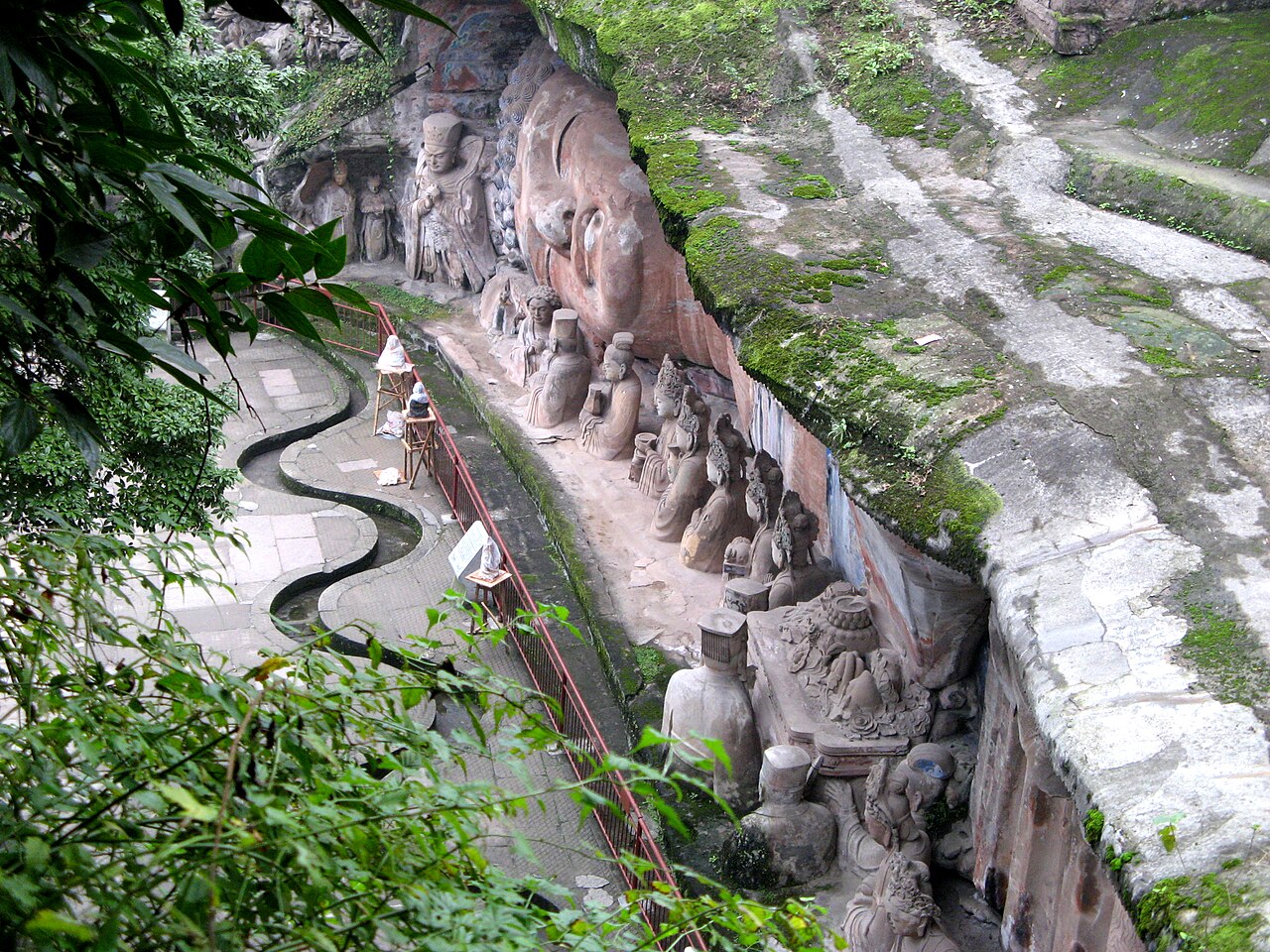
The supplied 2007 photograph depicts Baodingshan's actual Parinirvana group. It shows the reclining Buddha's head and long horizontal body above a row of other figures, together with the cliff and the visitor path of that date. Use the image to anticipate the difference in scale, not to assume the same camera position remains accessible. From a permitted position, first follow the broad horizontal composition, then choose a small group of attendants and see how their placement relates to the main figure.
Ask an interpreter who the identified figures are and how the scene communicates its subject. Separate what you can see from the meaning the explanation supplies. A hand position, robe or facial expression may be clearly visible without your being able to identify the person correctly. There is no need to invent a psychological story for every face. If the viewing area is crowded, take a first pass and return only if the current circulation allows it; do not occupy the narrowest section of the path while comparing photographs.
References: 3
Use one detailed relief and the museum to deepen the visit
Where open, give the Thousand-Armed Guanyin or another well-interpreted relief a different kind of attention. Look at how many repeated details combine into a larger form, then seek the explanation of the identified subject. Do not count every hand or assign an exact age to every surface from appearance alone. Ancient carving, surviving pigment, later intervention and conservation are different kinds of evidence. Ask which aspect the current interpretation is explaining. The old low-light Guanyin candidate examined for this guide was excluded rather than presented as a sharp current record.
If the museum is open and fits the day, use it for the questions the cliff view leaves unresolved: how a subject is identified, how inscriptions help establish context and how the carvings are conserved. Choose one display that answers a question from your visit. A museum explanation is more useful after you have seen the problem it addresses than as a rushed series of cases photographed on the way to lunch. Keep a meal and rest break before deciding whether Beishan still receives enough time.
References: 2
Beishan: make the second stop a close-looking visit
Travel to Beishan as a separate site, using its exact entrance and the current day-entry arrangements. The institute describes its concentration of cliffside niches and its fine carving. Choose a few clearly labelled examples rather than trying to inspect the entire cliff at equal depth. At each, first notice the frame and the relationship between central and accompanying figures. Then read the identification and date. This is a different rhythm from the monumental, extended scene at Baodingshan.
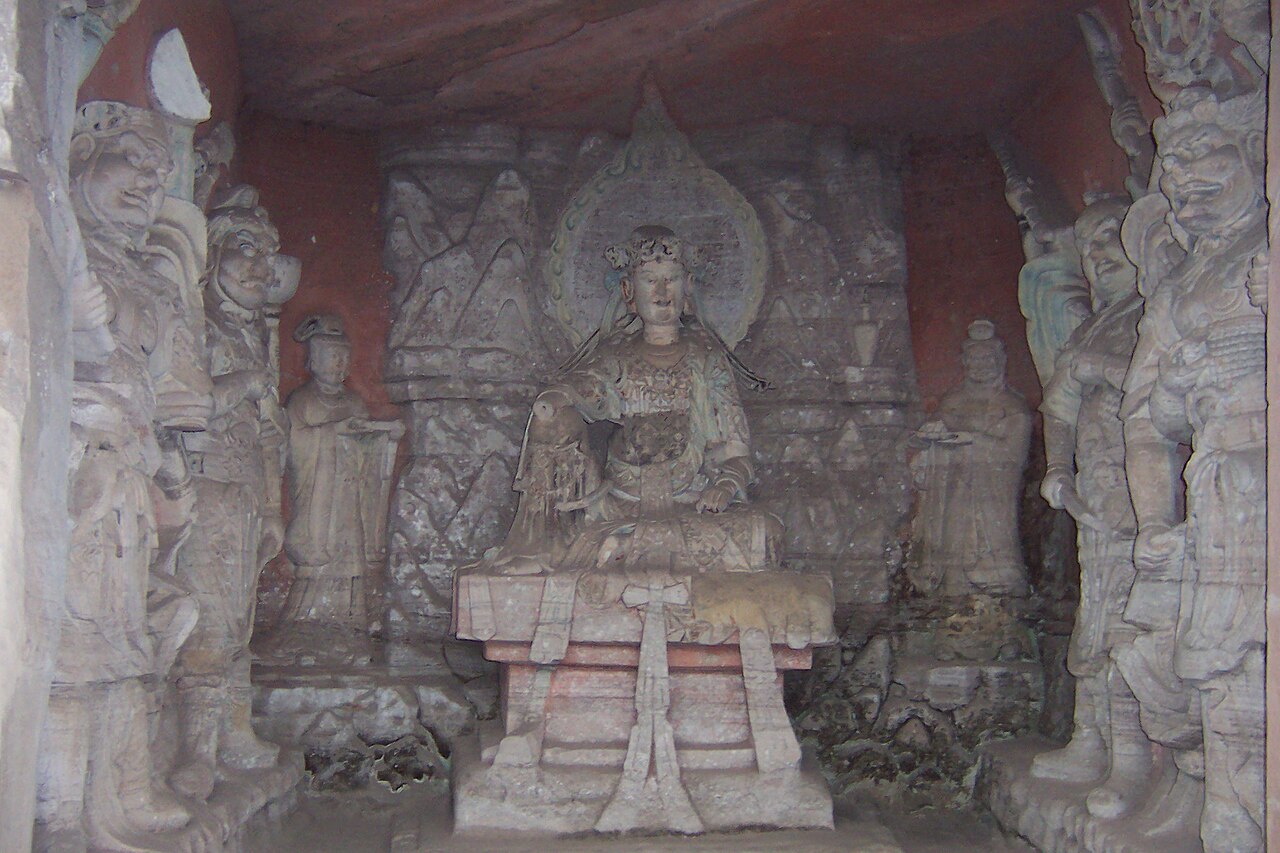
The supplied February 2007 photograph is a seated Guanyin group at Beishan, specifically identified by its creator. The figure, halo, neighboring attendants and niche are all part of the actual composition. Treat it as a dated visual record; current lighting, protection and viewing access may differ. If the exact niche is inaccessible, select another open, identified group and keep the comparison at the level the evidence supports. One well-understood niche can justify the second visit without claiming that you have surveyed all of Beishan.
Plan the return around the actual sites and the permitted path
Agree the transfer between Baodingshan and Beishan, your luggage arrangements and the return pickup before starting. A trip from central Chongqing, an arrival at a Dazu railway station and the final visitor-centre approach are different legs. Use current responsible transport information for the particular service you plan to take; do not treat the district name on a train ticket as proof that you are beside the carvings. Leave a margin for your actual onward connection rather than timing it against the final advertised closing minute.
Follow the institute's rules against touching the carvings and respect photography instructions. Ask about surfaces, steps and assistance for the precise route if needed. Bring suitable footwear, water and protection for the forecast. If delays make the second site rushed, finish Baodingshan and its interpretation properly, then return. A useful day leaves you able to describe a particular large scene and a particular niche, with their names and locations intact. The number of carvings glimpsed is less useful than that clear account.
References: 2
A two-site day with a clear fallback
Reserve a generous morning for Baodingshan and its approach, a proper meal break, and an afternoon block of roughly 90 minutes or more for selected Beishan niches, plus the actual transfers. These are editorial allowances, not measured queue or walking times. If starting late, retain the full Baodingshan visit and remove Beishan instead of reaching both sites too close to entry cutoffs.
Questions
Does the combination ticket include the digital film and all vehicles?
The institute lists carving admission, Baodingshan scenic transport and the digital film as distinct products. Read your actual purchase inclusions; the combination’s name alone does not establish those extras.
Will the site look exactly like the photographs?
The supplied images are real photographs from 2007. They identify the actual Baodingshan Parinirvana group and a Beishan Guanyin niche, but lighting, conservation, barriers and permitted viewpoints can change.
Sources and photography
- UNESCO: Dazu Rock Carvings
- Dazu Rock Carvings Research Institute: official visitor guide
- G41rn8: Baodingshan Parinirvana group
- Truthven: Beishan seated Guanyin
Photographs are credited beside each image. Their recorded capture dates describe the images; check the current visitor or product information linked above when planning.