Zuojiang Huashan: learn from rock art at landscape distance
Rock art does not always invite close inspection. A distant authorized view may reveal its relationship with cliff, river and surrounding land more clearly than an imagined close-up. At Zuojiang Huashan, treat distance as an interpretive question and build a visit around what a landscape view can honestly show.
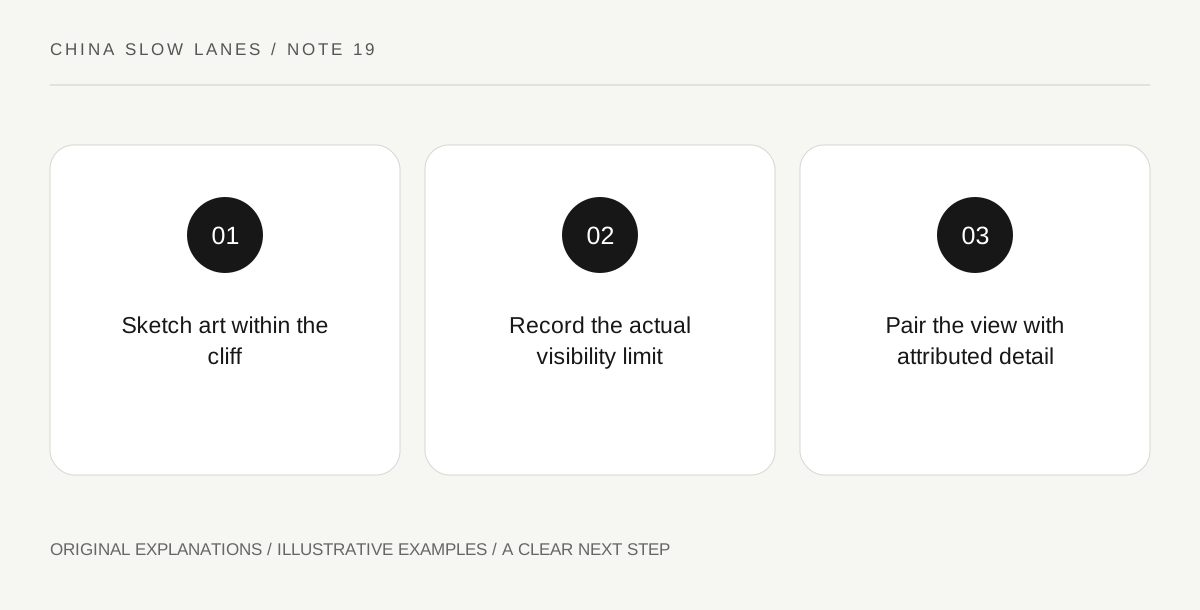
Original explanatory diagram. Read the full method and limitations below.
Put the cliff on the page first
UNESCO describes rock-art sites on steep cliffs within a karst, river and plateau landscape, with imagery interpreted in relation to Luoyue life and ritual. Begin a field sketch with cliff and surrounding landforms, then mark the area identified as rock art. Keep the mark small if it appears small from your actual viewpoint. Enlarging it on the page without explanation can erase the most important relationship you came to study: imagery placed within a much larger setting. A separate detail image can be added later from an authorized interpretive source.
Separate visibility from identification
At a distance, you may distinguish a colored area or repeated shapes without being able to identify an individual figure. Record exactly that level of visibility. Use binoculars only where permitted and safe, without obstructing others or leaning beyond a barrier. Do not turn a guidebook’s detailed description into something you claim to have seen unaided. An honest note might say that the overall placement was visible while figure details were learned from interpretation. That distinction makes the experience more credible and helps future visitors form realistic expectations.
Read an interpretation as an interpretation
The heritage account uses interpretive language about ceremonies and bronze-drum culture. Preserve that status when summarizing it. Archaeological interpretation connects evidence with an explanation; it is not the same as a visitor directly witnessing an ancient ceremony. In your notebook, keep visible forms, documented context and scholarly interpretation in separate lines. This is especially valuable with rock art, where an emotionally compelling image can encourage sweeping stories about meaning. A careful explanation remains interesting while acknowledging what kinds of evidence support it.
Make the wider landscape part of the memory
Finish with two records at different scales: a landscape relationship and a sourced detail study. Label the latter’s origin and avoid presenting it as your own close-access photograph. If the day’s authorized arrangements provide a limited view, work within that limit and choose a different question rather than seeking an unauthorized approach to a cliff. Your final paragraph can explain how placement affects the experience of looking. It need not solve the imagery’s entire meaning to show why the relationship between art and setting matters.
Illustrative field exercise
Illustrative record: from an authorized position, a visitor sees the identified painted zone but cannot resolve individual forms clearly. Their landscape sketch keeps the zone proportional to the cliff. Later, a museum reproduction supplies a closer view and is labeled as such. The paired page distinguishes field visibility from interpretive detail while showing why the imagery cannot be understood as a floating image without a landscape.
Questions that come up
Is a distant view less worthwhile than a close one?
It answers different questions. Placement and landscape relationships may be clearer from farther away, while details can be studied through authorized interpretive material.
Can I describe a ritual as established because a figure resembles an action?
Resemblance alone is not enough. Use the specific interpretation and its stated scope, and keep your visual impression separate from the historical explanation.
References and scope
These sources support the factual background. Examples and exercises are original illustrative teaching material. References do not imply endorsement.
- UNESCO: Zuojiang Huashan Rock Art Cultural Landscape — The cliff, karst and river setting and the interpreted relationship of imagery with Luoyue ritual and bronze-drum culture.