Mount Wuyi: give natural and cultural history their own pages
A place described through both natural and cultural significance can be flattened into scenery with a few historical labels attached. At Wuyi, use two parallel pages: one for landscape and habitat questions, another for human institutions and ideas. Bringing them together creates a richer visit without assuming that every component lies on one convenient route.
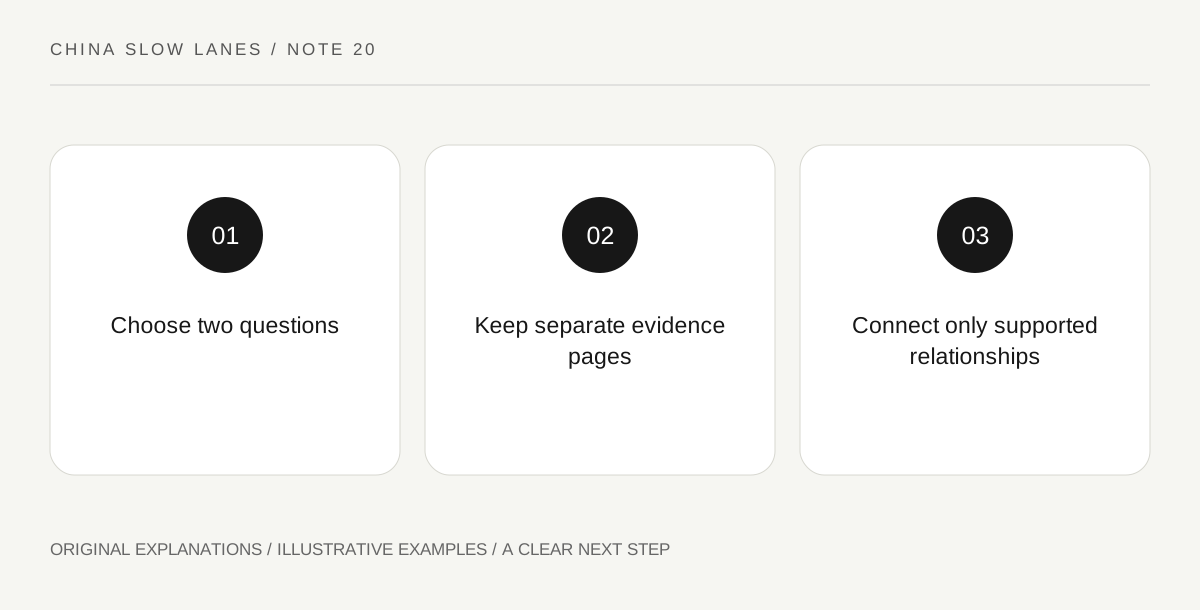
Original explanatory diagram. Read the full method and limitations below.
Set two different observation goals
UNESCO’s account of Wuyi includes biodiversity, the Nine Bend River landscape, religious and intellectual history, and the archaeological city at Chengcun. These are connected subjects with different evidence. Choose one landscape question and one cultural question relevant to the authorized components you will visit. For example, ask how landforms organize a view and what an interpreted institution contributed historically. This gives each subject enough attention rather than using a cultural building merely as a decorative stop between scenic photographs.
On the landscape page, describe before identifying
Record visible layers such as foreground vegetation, a slope and a more distant landform from a safe public position. Name a species only when a reliable label or qualified source identifies it. A general appreciation of biodiversity does not mean that a visitor can recognize rare species by sight. If a route is designated for visitors, remain on it and avoid collecting plants or disturbing habitat. Your page can be useful with careful descriptions and a few well-supported identifications; it does not need an impressive but uncertain species list.
On the cultural page, locate an idea in a place
At an interpreted cultural component, note its actual name, the historical subject explained and the surviving or presented evidence. Distinguish a ruin, a later building and a reconstruction if those categories apply. An intellectual tradition cannot be fully understood from a building’s appearance, but a place can provide a concrete starting point for learning. Write one question that the visit raises and one source you can consult afterward. This connects travel with study without pretending that a short stop supplies mastery of a complex philosophy or religious history.
Connect the pages with a modest claim
At the end, write a sentence about a relationship you can support: a cultural place sits within a particular landscape, or the interpretation describes a historical association with that setting. Avoid inventing a universal explanation that scenery automatically produces a certain belief. Keep the archaeological city as a separate itinerary decision if it does not fit your route. The two-page method works even when you see only selected components, because it makes the scope of the visit visible and gives each kind of significance a clear question.
Illustrative field exercise
Illustrative plan: a traveler chooses one authorized landscape route and one interpreted cultural stop. The first page contains a layered view with only one reliably identified plant. The second names the institution and summarizes a sourced historical association. Chengcun remains a separate future visit. A final connecting sentence explains the setting they actually encountered without implying that one route covered every natural and cultural component of Wuyi.
Questions that come up
Does mixed heritage status mean every viewpoint shows both values?
No. A particular stop may illuminate one aspect more clearly. The two-page method helps connect selected experiences without forcing every view to carry the whole property’s significance.
Should I add Chengcun automatically to a scenic day?
Only when current access, travel time and interests support it. Its archaeological subject deserves a deliberate visit rather than an assumed extension of a scenic route.
References and scope
These sources support the factual background. Examples and exercises are original illustrative teaching material. References do not imply endorsement.
- UNESCO: Mount Wuyi — The natural and cultural significance, Nine Bend River setting, intellectual history and Chengcun archaeological component.