Qufu: give temple, mansion and cemetery separate meanings
One heritage title joins three kinds of place at Qufu, but their purposes are not interchangeable. A temple, a family residence and a cemetery invite different questions about commemoration, household life and ancestry. Use that distinction to choose a manageable visit and build a clearer memory of the components you encounter.
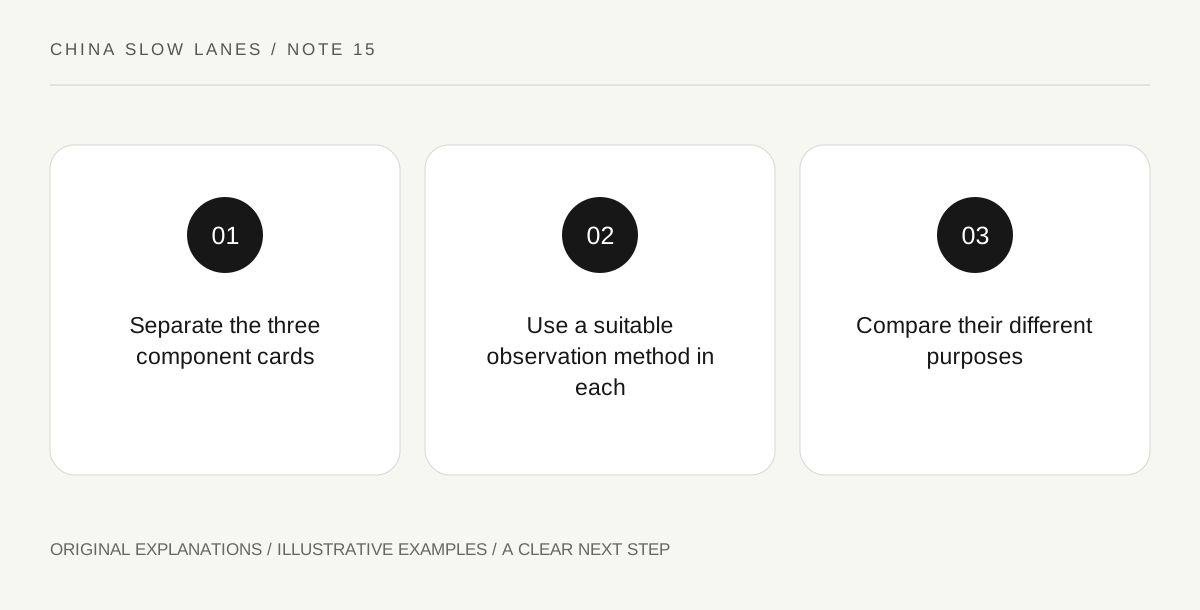
Original explanatory diagram. Read the full method and limitations below.
Write a purpose beside each component
UNESCO’s Qufu property includes the Temple of Confucius, the Kong Family Mansion and the cemetery. Before planning movement, put those names on separate cards and add a question: how is a person commemorated, how is a family institution housed, and how is ancestry expressed? These are starting questions rather than complete historical definitions. They prevent the three components from merging into one generic palace visit. You can select one or two according to interests while still understanding what the wider property title contains.
Use space differently at the temple
On a permitted temple route, notice the sequence of approach and enclosed spaces. Record the point where a building first becomes visible and the position from which visitors encounter it. Then consult interpretation about commemoration and historical use. Do not assume that a current visitor route reproduces an old ceremony exactly. The exercise studies how the surviving place is experienced today, with documented information adding the historical layer. A modest spatial note is more useful than claiming to have reconstructed ritual from a walk through a few courts.
Ask residence questions at the mansion
In the mansion, focus on how interpretation distinguishes household, administrative or other identified functions. Draw a room-function diagram using only labels actually supplied. A large residence can contain many kinds of space, and its grand appearance does not answer how people used them. Notice which transitions are open to visitors and which are not. A route through selected rooms is a presentation of the institution, not permission to imagine private life in every detail. Keep physical observations separate from any stories about particular family members.
Give the cemetery a quieter mode of attention
A cemetery deserves a pace and manner appropriate to commemoration. Follow the permitted route, respect other visitors and any ongoing practices, and use interpretation to understand ancestry rather than treating graves as a list of photographic targets. The key comparison is the different work done by the three places: commemorative institution, residence and burial landscape. Finish by writing one sentence for each visited component. If one remains unvisited, leave its sentence as a research question. An honest partial visit can still make the whole title much more intelligible.
Illustrative field exercise
Illustrative plan: a traveler has time for the temple and mansion but not the cemetery. They reserve separate observation pages, using a sequence sketch at the temple and a labeled function diagram at the mansion. The cemetery card remains marked “not visited.” Their final paragraph explains the two institutions they encountered and identifies ancestry as a subject to explore later, instead of implying a complete three-part visit.
Questions that come up
Is the family mansion simply another temple building?
The property joins related but distinct components. The mansion’s residential and institutional history deserves its own questions instead of being folded into a generic temple description.
Can a one-component visit still be meaningful?
Yes. Knowing the wider composition helps you make a deliberate selection. Describe the part you actually visited and preserve other components as future questions.
References and scope
These sources support the factual background. Examples and exercises are original illustrative teaching material. References do not imply endorsement.
- UNESCO: Temple and Cemetery of Confucius and the Kong Family Mansion in Qufu — The three distinct components and their commemorative, residential and ancestral associations.