Temple of Heaven: sketch shapes before interpreting symbols
Recognizable geometry can make the Temple of Heaven seem easy to understand from a single photograph. A slower exercise begins with shapes and their arrangement, then asks what interpretation says they mean. This order allows symbolic learning to grow from careful observation while avoiding the temptation to assign a meaning to every visible number or curve.
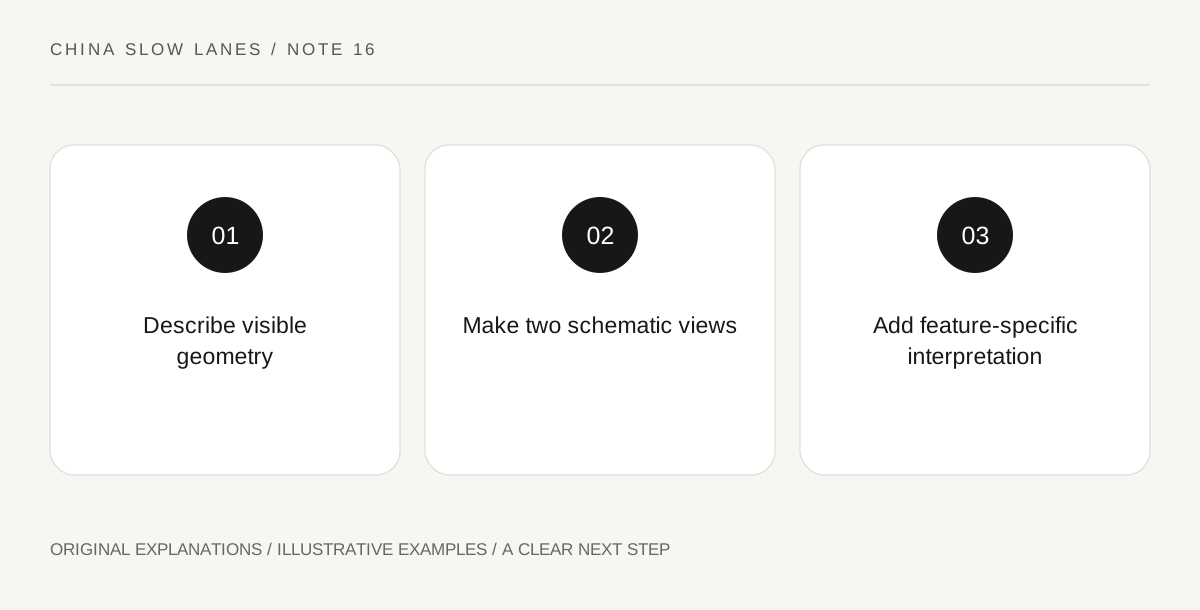
Original explanatory diagram. Read the full method and limitations below.
Observe without a symbolic shortcut
UNESCO describes the Temple of Heaven as an imperial sacrificial complex whose layout expresses a relationship between heaven, earth and the emperor. That is a historical frame, not permission to invent a symbolic explanation for every feature. On a public route, select one view and list its visible geometric relationships in plain words: curved or straight, enclosed or open, centered or offset. These descriptive pairs give you something concrete to discuss when reading the interpretation. They also work when a particular monument is crowded or partially obscured.
Draw a plan and a profile
A plan-like sketch asks how forms are arranged across the ground. A profile asks how they rise. Make both loosely, labeling them schematic rather than measured. The two drawings may emphasize different relationships: alignment in one and changes of height in the other. Do not force them into perfect symmetry if your viewpoint does not establish it. A visitor’s sketch is useful because it reveals what you noticed and what you could not determine. The official plan can later answer questions that a single perspective leaves unresolved.
Attach interpretation to an exact feature
When a panel explains symbolism or ritual purpose, note the particular building, platform or layout relationship it concerns. Keep that explanation beside the relevant part of the sketch. This stops a memorable fact from drifting onto the wrong structure in your recollection. If a popular claim about a number or acoustic effect is not supported by the interpretation you consulted, record it as unverified rather than repeating it as a discovery. You are building a small reliable account, not competing to collect the greatest number of extraordinary stories.
Let the surrounding space matter
Include the setting around the selected monument in one observation. A visitor encounters open space, vegetation, routes and changing distance as well as the building itself. From a permitted stopping point, describe how the approach changes what dominates the view. Keep the note about current experience separate from any claim about historical ritual movement. Finish by comparing your first shape description with the interpretation you added later. The result should be one understandable relationship between form and meaning, with uncertainty preserved where the evidence did not answer a question.
Illustrative field exercise
Illustrative page: a traveler sketches a curved outline in profile and a relationship of aligned elements in a plan-like drawing. The panel supplies a symbolic explanation for one identified feature, which is attached to that feature alone. A story heard elsewhere about a special number stays in the questions column. The page becomes a record of learning rather than a collection of unattached architectural legends.
Questions that come up
Does every repeated number have a symbolic meaning?
Do not assume so from repetition alone. Consult a source that explains the particular feature and preserve the scope of that explanation.
Can I learn something if I only have time for one monument?
Yes. One carefully drawn form and one well-supported relationship between form and meaning can provide a coherent visit without attempting to cover the entire complex.
References and scope
These sources support the factual background. Examples and exercises are original illustrative teaching material. References do not imply endorsement.
- UNESCO: Temple of Heaven: an Imperial Sacrificial Altar in Beijing — The sacrificial complex and the symbolic relationship expressed through its layout and buildings.