Yin Xu: connect a written mark with the material that carries it
Ancient writing can be treated as a row of mysterious signs or as evidence embedded in a physical object. At Yin Xu, follow the second route. Look at material, mark and archaeological context in separate stages, using interpretation to connect them rather than expecting a familiar-looking sign to explain itself.
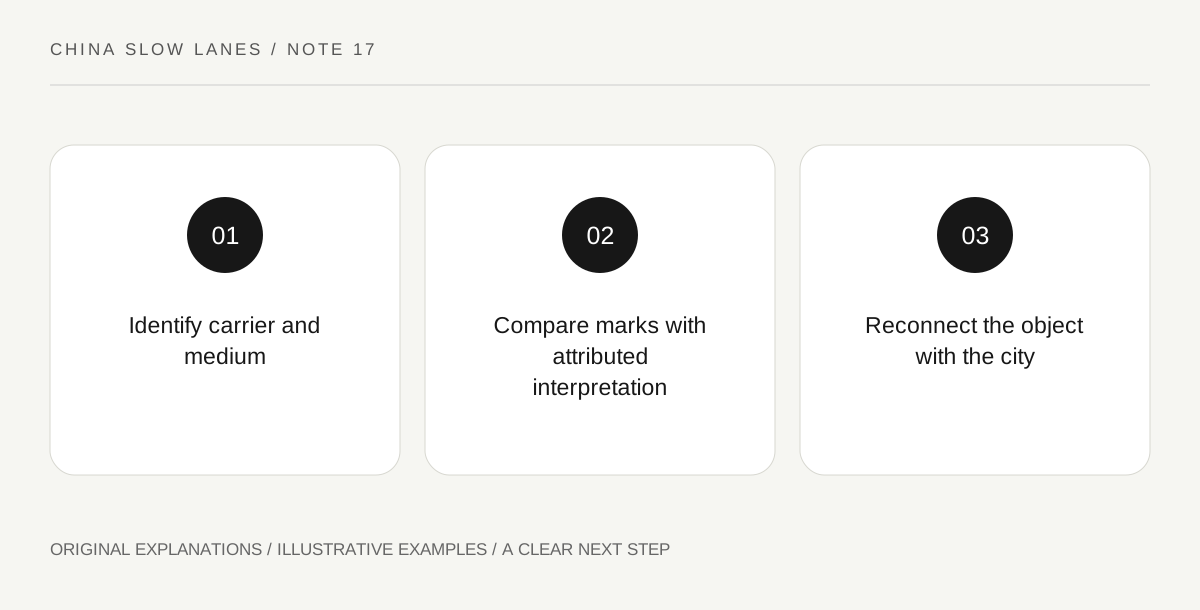
Original explanatory diagram. Read the full method and limitations below.
Start with the object before the sign
UNESCO identifies Yin Xu as a late Shang capital and highlights oracle-bone inscriptions as evidence for early writing and social and belief systems. In an authorized display, select a labeled example and begin with the object’s physical form. Note its identified material, surviving outline and display orientation. A mark does not float independently of its carrier. Looking at the whole object first helps you understand why an isolated enlarged character in a textbook is a different kind of presentation from an excavated inscribed piece.
Distinguish a copy from an original
Displays may use photographs, tracings, replicas or reconstructions to make difficult material legible. Record the medium that you are viewing. An enlarged tracing can reveal a line that is hard to see on the object, but it is still an interpretive presentation. A replica can communicate shape without being the excavated item. These distinctions do not diminish the display; they explain how it teaches. Your notes should let a later reader know whether you observed a physical surface, studied a reproduction or read a translation supplied by the institution.
Use translation with its attribution
If a label provides a reading or translation, copy a brief identification in your own words and attribute it to the display. Do not infer the meaning of an ancient sign solely because it resembles a modern character or picture. Shape comparison can be an interesting learning question, but a historical reading requires expertise and context. Keep a three-part note: visible form, supplied interpretation and remaining question. That arrangement gives beginners a way into the material while respecting the difference between curiosity and a claim to decipherment.
Return the object to the city
Before leaving, connect the selected object with the wider archaeological account. A city site includes buildings, burials, production and other evidence, not just writing. Use an interpreted plan or display to locate the kind of context described for your example, without inventing a precise find spot. Finish with one sentence explaining what the inscription contributes and another explaining what other evidence is needed. This makes writing part of an inhabited historical world, rather than a magical key that can independently answer every question about an ancient society.
Illustrative field exercise
Illustrative exercise: a visitor chooses a labeled inscribed fragment and records its material and outline. An enlarged tracing beside it becomes a separate entry, clearly marked as a reproduction. The label’s interpretation is summarized with attribution, while a resemblance to a modern character stays a question. A final plan note connects the discussion to the wider late Shang capital instead of treating the fragment as a complete history.
Questions that come up
Can I translate an oracle-bone sign by recognizing a modern character?
Visual resemblance alone is not a reliable translation method. Treat it as a question for a suitable scholarly explanation, and use the institution’s identified reading for the displayed example.
Are replicas less useful than originals for learning?
They can be useful for scale, shape and visibility when clearly labeled. The important point is to record what you viewed instead of silently describing a reproduction as the excavated object.
References and scope
These sources support the factual background. Examples and exercises are original illustrative teaching material. References do not imply endorsement.
- UNESCO: Yin Xu — The late Shang capital, archaeological remains and the significance of oracle-bone inscriptions.