Yungang: manage visual density with a looking score
A richly carved cave can offer more detail than a first visit can absorb. At Yungang, use a short looking score: overall space, main arrangement, one secondary feature and a final return to the whole. The sequence is a practical aid to attention, not a claim that every cave follows the same design.
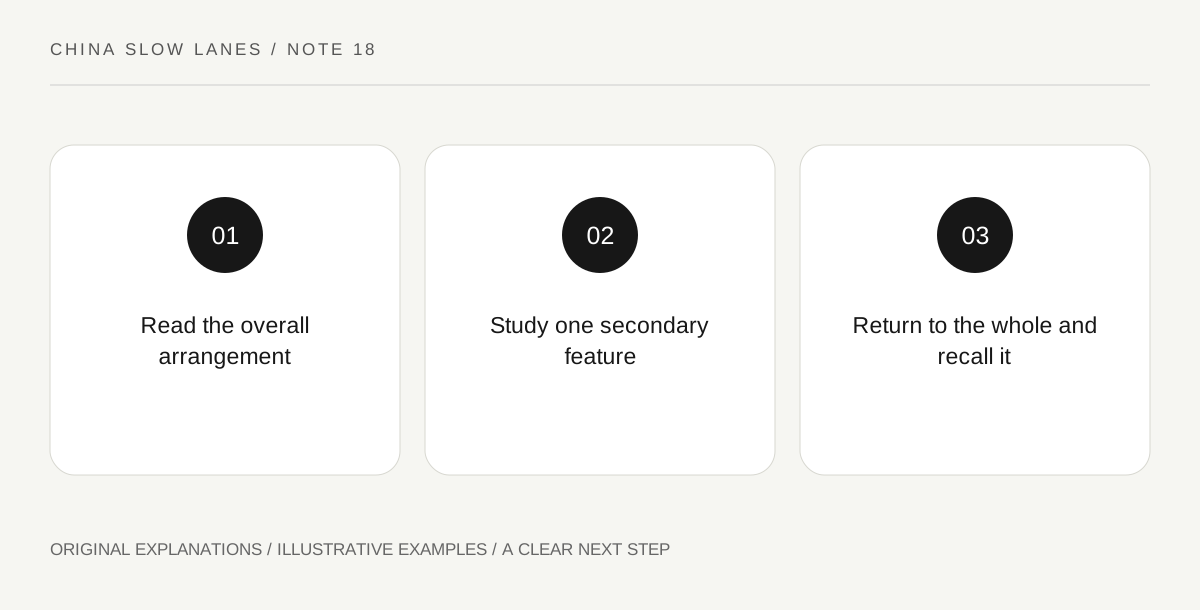
Original explanatory diagram. Read the full method and limitations below.
Choose one permitted encounter
UNESCO recognizes Yungang’s Buddhist cave art of the fifth and sixth centuries and emphasizes the unified design of the Five Caves associated with Tan Yao. Select an accessible interpreted cave or viewing position rather than trying to apply this exercise everywhere. Note the actual location and visitor restrictions. A cave that is closed or visible only from a defined point remains outside your planned close study. Conservation limits are part of the encounter, and a method that requires crossing them is simply the wrong method for that day.
Count relationships rather than sculptures
Begin with a broad description of where the largest forms sit and how smaller forms relate to them. You do not need a complete count. Use a simple diagram with circles or blocks to show relative positions, clearly labeled schematic. This reduces visual overload while preserving organization. A detailed inventory might be appropriate for specialist research, but a first visitor gains more by understanding a few relationships. Do not turn the sketch into an iconographic interpretation until you have consulted the cave’s actual explanatory material.
Let one small feature slow the pace
After the overview, choose one visible secondary feature that interests you. It might be a repeated pattern, a figure’s position or an architectural-looking frame, depending on the encounter. Describe it in a sentence without requiring a photograph. Where photography is allowed, follow the restrictions and avoid extending the stop into other visitors’ circulation. The purpose is to give one detail enough attention to become memorable, not to collect every possible close-up. A modest feature can make the larger composition easier to recognize afterward.
Return to the whole and test the memory
Look back at the overall arrangement and ask whether the small feature changes how you understand it. Then, away from the viewing position, write a three-sentence account without consulting your photographs. Include the cave identification, one spatial relationship and one detail. Read the interpretation again if the account contains an uncertain historical claim. The result is a compact, honest memory. When several caves blur together, these short records help preserve differences while admitting that one visit cannot master the site’s entire artistic history.
Illustrative field exercise
Illustrative looking score: a traveler spends an initial pause on the main arrangement, a second on a permitted visible detail and a final moment on the whole. Their later note names the cave, places a smaller form relative to a larger one, and records a repeated pattern. A historical explanation is attributed to the panel; the sketch itself makes no claim to identify every figure.
Questions that come up
Should I photograph every cave to remember the differences?
A smaller set of identified contextual records is often easier to use. Accurate location notes and a short written comparison can preserve differences better than many unlabeled images.
Is the looking score an archaeological classification?
No. It is an original attention exercise for visitors. Historical and iconographic identification still depends on appropriate interpretation and scholarship.
References and scope
These sources support the factual background. Examples and exercises are original illustrative teaching material. References do not imply endorsement.
- UNESCO: Yungang Grottoes — The fifth- and sixth-century Buddhist cave art and the design significance of Tan Yao’s Five Caves.